

ADHD Support Pathway Finder
Answer these questions about your child's current situation to get a recommendation on which support plan may be most appropriate.
Recommended Pathway
- Gather report cards and teacher comments.
- Email principal requesting evaluation in writing.
- Attend eligibility meeting.
- Negotiate specific accommodations/goals.
You sit in a meeting with school administrators, teachers, and maybe a psychologist. The topic is your child’s ADHD, which stands for Attention-Deficit/Hyperactivity Disorder, a neurodevelopmental condition that affects focus, impulse control, and activity levels. The question on the table isn’t just about diagnosis; it’s about legal protection. Does your child need a 504 Plan or an Individualized Education Program (IEP)? It feels like picking between two similar boxes at the grocery store, but the difference changes everything.
This confusion is common. Both plans come from federal laws designed to help students with disabilities succeed. Both offer accommodations. But they operate under different rules, provide different levels of support, and require different commitments from the school. Getting this wrong can mean your child misses out on crucial resources or, conversely, gets more structure than they actually need. Let’s break down exactly what each plan is, how they differ, and which one fits your situation.
The Legal Foundation: Section 504 vs. IDEA
To understand the plans, you first need to understand the laws behind them. They are not interchangeable terms; they are distinct legal frameworks.
A 504 Plan is based on Section 504 of the Rehabilitation Act of 1973, a civil rights law that prohibits discrimination against individuals with disabilities in programs receiving federal financial assistance. This law is broad. It covers anyone with a physical or mental impairment that substantially limits one or more major life activities. In the context of school, "major life activities" includes learning, reading, concentrating, and thinking. If ADHD significantly impacts your child’s ability to learn in a general education classroom, they likely qualify for a 504 Plan.
An IEP, or Individualized Education Program, is mandated by the Individuals with Disabilities Education Act (IDEA), a federal law that ensures students with disabilities receive a Free Appropriate Public Education (FAPE) tailored to their unique needs. IDEA is narrower and more specific. To qualify, a student must fall into one of thirteen specific disability categories defined by the law and must demonstrate that their disability requires specialized instruction, not just accommodations. ADHD is one of those eligible categories under IDEA, but only if it causes significant educational impact that regular classroom adjustments cannot fix.
| Feature | 504 Plan | IEP |
|---|---|---|
| Legal Basis | Section 504 of the Rehabilitation Act (Civil Rights) | IDEA (Education Law) |
| Goal | Level playing field (access) | Individualized progress (instruction) |
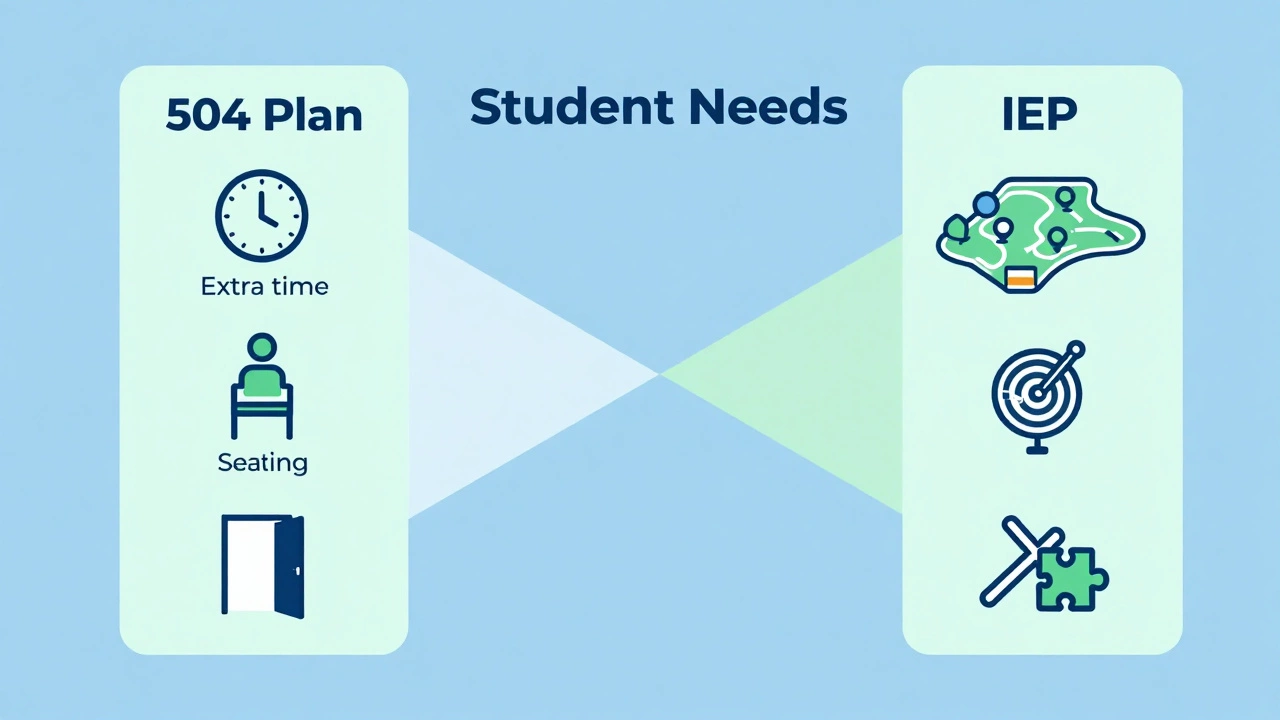
| Services Provided | Accommodations only (e.g., extra time, seating) | Accommodations + Specialized Instruction (e.g., speech therapy, resource room) |
| Team Composition | Parents, teachers, school admin | Parents, gen ed teacher, spec ed teacher, admin, evaluator, sometimes student |
| Review Frequency | Annually (informal) | Annually (formal meeting required) |
| Progress Monitoring | General grades/behavior reports | Specific, measurable goals tracked regularly |
What Is a 504 Plan?
Think of a 504 Plan as a set of adjustments to the environment. It does not change what is being taught, but it changes how the student accesses that teaching. For a student with ADHD, this might look like sitting near the front of the class to minimize distractions, getting extended time on tests to account for processing speed issues, or having assignments broken into smaller chunks.
The process is generally less formal than an IEP. There is no strict timeline mandated by federal law for evaluations or meetings, though schools usually follow state guidelines. The team creating the plan is often smaller, typically consisting of parents, a general education teacher, and a school administrator or counselor. Because the bar for qualification is lower-any impairment limiting a major life activity qualifies-more students have 504 Plans than IEPs.
However, because it is a civil rights law rather than an education law, enforcement can be trickier. If a school fails to implement a 504 Plan, you are fighting a discrimination case. If they fail to implement an IEP, they are failing to provide legally mandated educational services. The latter often carries more weight in terms of procedural safeguards and due process rights.
What Is an IEP?
An IEP is a comprehensive roadmap. It is a legal document that outlines specific educational goals and the specialized services the school will provide to help the student reach them. If your child with ADHD struggles so much that they are falling behind in reading comprehension despite standard tutoring, or if they need explicit instruction in executive functioning skills, an IEP is likely necessary.
The IEP team is larger and more specialized. It must include a representative of the school district who is qualified to provide or supervise specially designed instruction, someone who can interpret evaluation results (like a psychologist), and parents. The document itself is detailed. It includes:
- Present Levels of Academic Achievement and Functional Performance (PLAAFP): A snapshot of where the student is now.
- Measurable Annual Goals: Specific targets, such as "Student will complete 80% of math problems independently within 20 minutes."
- Special Education and Related Services: Details on how much time the student spends in special education classes, resource rooms, or receiving therapies (speech, occupational, counseling).
- Modifications: Changes to what is expected (e.g., reduced homework load, alternative assessments).
IEPs require rigorous documentation. The school must evaluate the child using a variety of tools, not just IQ tests. They must also hold formal meetings at least once a year to review progress. If the student isn’t making progress, the plan must be adjusted. This level of accountability is the biggest advantage of an IEP over a 504 Plan.
Does ADHD Qualify for Either?
Yes, ADHD can qualify for both, but the criteria differ significantly.
For a 504 Plan: You need medical documentation (usually from a doctor or psychologist) diagnosing ADHD. You then need to show that this diagnosis substantially limits a major life activity, such as learning or concentrating. Most students with a clinical diagnosis of ADHD who are struggling in school will easily meet this threshold. The school may request their own evaluation, but they often accept outside private evaluations.
For an IEP: The bar is higher. First, ADHD must be listed as a disability category under IDEA (it falls under "Other Health Impairment"). Second, and crucially, the school must determine that the ADHD adversely affects educational performance to the extent that the child requires specially designed instruction. Simply having a hard time focusing isn’t enough. The school must prove that standard accommodations (the kind found in a 504 Plan) are insufficient. They need to see data showing that despite interventions, the child is not accessing the curriculum effectively.
If your child is keeping up with grades but just needs extra time on tests, a 504 Plan is usually sufficient. If your child is failing subjects, has severe behavioral issues impacting learning, or needs pull-out services for social skills or organizational training, an IEP is the better path.
How to Choose: Practical Steps
Choosing between the two isn’t always a binary decision made in a vacuum. Here is a practical approach to navigating the process.
- Gather Data: Before requesting anything, collect evidence. Keep copies of report cards, teacher comments, work samples, and any private psychological evaluations. Note specific incidents where ADHD impacted learning (e.g., "Did not turn in assignment because forgot," not just "is lazy").
- Request an Evaluation in Writing: Email the school principal or special education director. State clearly that you are requesting an evaluation for special education services under IDEA and/or a 504 evaluation. Written requests create a paper trail, which is vital if disputes arise.
- Attend the Eligibility Meeting: The school will present their findings. Listen carefully. Do they say your child needs "accommodations" or "specialized instruction"? If they lean toward accommodations, push for a 504. If they acknowledge significant academic gaps requiring targeted teaching, push for an IEP.
- Negotiate the Plan: Whether it’s a 504 or IEP, the draft is rarely perfect. Be specific. Instead of "help with organization," ask for "a weekly binder check with a designated staff member." Vague language leads to vague implementation.

Common Pitfalls to Avoid
Many parents make mistakes during this process that delay support. One common error is assuming the school knows the difference between the two plans. They often don’t explain it well, or they may steer you toward a 504 Plan because it is administratively easier for them. An IEP requires more paperwork, more staff involvement, and more funding. Schools may subtly discourage IEPs. Know your rights. If your child needs specialized instruction, do not settle for a 504 Plan just because it’s faster.
Another pitfall is waiting too long. Early intervention is critical for ADHD. If your child is already in third grade and struggling, do not wait until fifth grade to act. The longer the gap between need and support, the harder it is to catch up.
Finally, do not assume a diagnosis equals an automatic IEP. A private diagnosis is powerful evidence, but the school is responsible for determining eligibility under federal law. They can disagree with your assessment of the educational impact. That’s why data collection is key. Show them the impact, not just the label.
Transitioning and Long-Term Impact
As children grow, their needs change. A 504 Plan might be perfect for elementary school, where accommodations like preferential seating work wonders. By middle school, the workload increases, and the need for organizational support grows. At that point, you might transition to an IEP to get access to a study skills class or a resource room.
Conversely, some students start with an IEP and, after years of support, no longer need specialized instruction. They might graduate to a 504 Plan for high school, needing only test-taking accommodations for college entrance exams. The goal is always independence. The plan should evolve as the student does.
In college, neither 504 nor IEP exists in the same form. Colleges are governed by the Americans with Disabilities Act (ADA). Students must self-disclose their disability and provide current documentation. They receive accommodations (like note-takers or extended time) but do not receive specialized instruction or monitoring. Therefore, the K-12 years are about building the skills and self-advocacy needed to navigate that post-secondary world. An IEP often provides more structured practice in self-advocacy through annual meetings and goal-setting, which can be beneficial for older students.
Can a student have both a 504 Plan and an IEP?
Technically, yes, but it is rare and usually unnecessary. An IEP is more comprehensive than a 504 Plan. If a student qualifies for an IEP, all the accommodations available in a 504 Plan can be included in the IEP. Having both creates redundancy and administrative confusion. Typically, schools will consolidate services into the IEP.
How long does the evaluation process take?
Federal law sets a 60-day timeline for IEP evaluations from the date of parental consent, though this varies by state. Some states have shorter timelines (e.g., 30 days). For 504 Plans, there is no federal deadline, but most districts aim to complete the process within 30-45 days. Delays happen, so follow up in writing if you don’t hear back.
What if the school denies my request for an IEP?
If the school determines your child does not qualify for an IEP, they must provide you with a Prior Written Notice explaining why. You have the right to disagree. You can request mediation, file a due process complaint, or pursue an independent educational evaluation (IEE) at public expense if you disagree with the school’s assessment.
Do 504 Plans affect college admissions?
No. Neither 504 Plans nor IEPs are part of your permanent academic record sent to colleges. Colleges do not see these documents. However, the accommodations and skills learned while on these plans can help improve grades and standardized test scores, which do matter for admissions.
Is medication considered an accommodation?
Medication is a medical treatment, not a school accommodation. However, a 504 Plan or IEP can include provisions related to medication, such as allowing the student to take medication at school if prescribed, or scheduling breaks for side effects. The plan supports the management of the condition, but the school does not prescribe or manage the medication itself.








Write a comment