

GCSE Revision Planner & Strategy Generator
Select the subjects you are revising for:
Three months might sound like an eternity when you’re staring at a pile of textbooks, but in the world of GCSE revision, it’s actually the sweet spot. It’s long enough to cover every topic without burning out, yet short enough to keep the pressure real. If you start now, you have exactly 12 weeks to transform confusion into confidence. The question isn’t whether three months is enough-it’s whether you can use them wisely.
The Reality of a 12-Week Timeline
Let’s be honest: cramming everything in the last two weeks is a recipe for disaster. But starting too early often leads to forgetting what you learned by exam day. Three months hits that perfect balance. You have time to build knowledge, practice application, and then refine your technique. Think of it like training for a marathon. You wouldn’t run 42 kilometers on Monday and race on Sunday. You need consistent, structured effort over time.
For most students, this period aligns with the final stretch before exams begin. In Ireland and the UK, this often means late winter or early spring. The weather is grey, motivation dips, and distractions loom. That’s why structure matters more than willpower. Your brain needs repetition to move information from short-term to long-term memory. Spaced repetition-the science of reviewing material at increasing intervals-is your best friend here. Instead of studying biology for five hours straight, you study it for one hour today, review it in two days, and test yourself again in a week.
Building Your Battle Plan
You don’t need a fancy app or a tutor to create a solid plan. You need a calendar and honesty about your weaknesses. Start by listing all your subjects and their exam dates. Work backward from the first exam. This creates a natural priority list. Subjects with earlier exams get more attention initially, while later subjects require maintenance reviews.
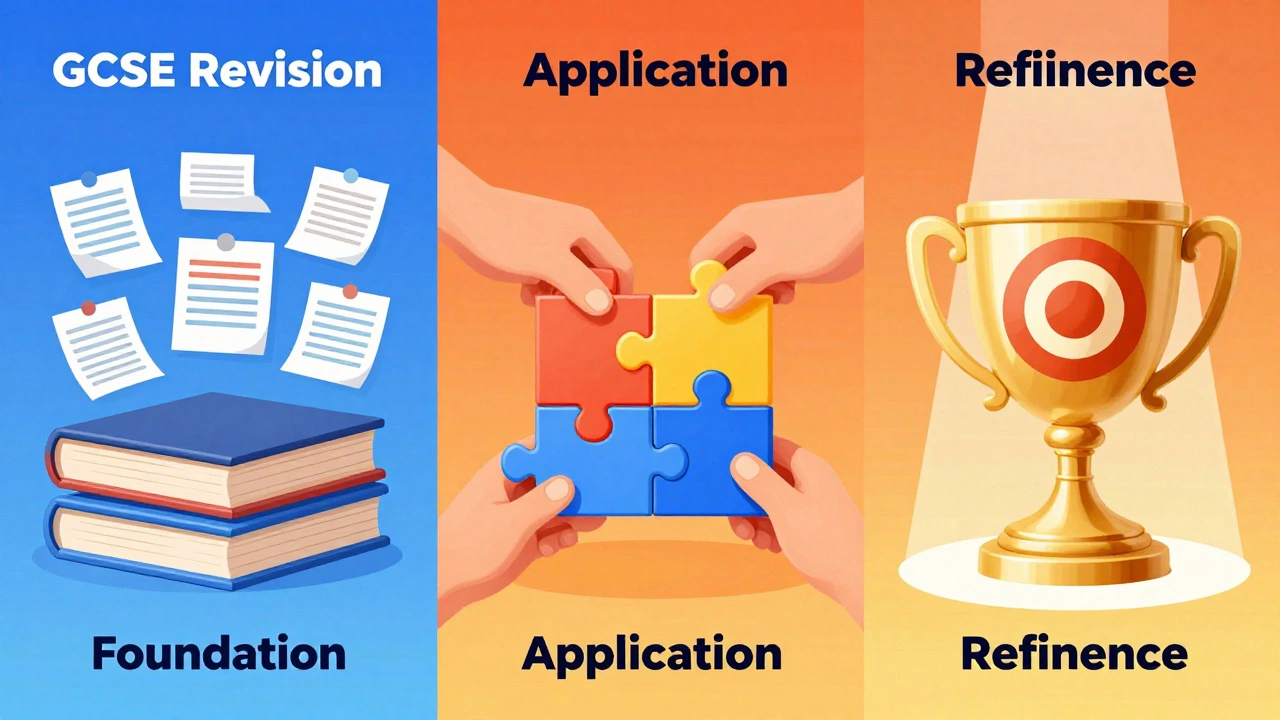
| Phase | Duration | Focus | Key Activity |
|---|---|---|---|
| Foundation | Weeks 1-4 | Covering content gaps | Notes, videos, textbook reading |
| Application | Weeks 5-8 | Practicing skills | Past papers, problem-solving |
| Refinement | Weeks 9-12 | Exam technique & timing | Timed mocks, error analysis |
In the Foundation phase, identify what you don’t know. Use active recall techniques-close the book and write down everything you remember about a topic. Then check for errors. This highlights weak spots faster than passive reading. During the Application phase, shift from learning to doing. Solve problems, write essays, and answer questions under mild time pressure. Finally, the Refinement phase is about simulating exam conditions. Time yourself strictly. Review mistakes not just for the right answer, but for the reason you got it wrong. Was it a knowledge gap? A misread question? Or poor time management?
Subject-Specific Strategies
Not all subjects are revised the same way. Treating Mathematics like History will waste valuable time. Here’s how to approach different types of subjects effectively.
STEM Subjects (Mathematics, Physics, Chemistry): These require practice, not memorization. You can’t learn physics by reading about Newton’s laws; you learn by solving force problems. Dedicate 70% of your time to past paper questions. When you get stuck, look up the specific concept, understand it, and immediately try another similar problem. Create a “mistake log” where you record tricky questions and revisit them weekly.
Humanities (History, Geography, Politics): Focus on argument structure and key facts. For History, master the causes, events, and consequences of major topics. Practice writing timed essay plans rather than full essays until the final month. Know your dates and names cold. For Geography, combine physical processes with case studies. Link theories to real-world examples like deforestation in the Amazon or urban growth in Lagos.
Languages and Literature: Consistency beats intensity. Spend 30 minutes daily on vocabulary and grammar. Read texts actively, annotating themes and character development. For literature, prepare flexible quotes that can apply to multiple essay questions. Don’t memorize entire essays; memorize ideas and evidence that you can adapt.
Avoiding Common Pitfalls
Even with a great plan, students fall into traps that derail progress. Recognizing these early saves weeks of wasted effort.
- The Highlighter Illusion: Highlighting text feels productive but rarely aids retention. Your brain glazes over familiar words. Replace highlighting with summarizing in your own words or teaching the concept to an imaginary audience.
- Passive Video Watching: Educational YouTube channels are helpful, but only if you pause and take notes. Watching four hours of videos without interacting is entertainment, not study.
- Igoring Weak Subjects: Avoidance is natural. We gravitate toward subjects we already enjoy. But your lowest grade has the most potential for improvement. Tackle your hardest subject when your energy is highest, usually morning.
- Skipping Sleep: Pulling all-nighters destroys memory consolidation. Sleep is when your brain files away what you learned. Aim for seven to eight hours. A tired brain learns slower and makes more careless errors.

Maintaining Momentum
Discipline fades; systems endure. Build habits that make studying automatic. Use the Pomodoro Technique: 25 minutes of focused work followed by a five-minute break. After four cycles, take a longer break. This prevents mental fatigue and keeps concentration sharp. Track your progress visually. Cross off completed topics on a checklist. Seeing tangible progress boosts motivation more than vague goals like “study harder.”
Also, manage your environment. Remove distractions. Put your phone in another room during study blocks. Keep your desk clear except for current materials. If you study in the same place every day, your brain associates that space with focus. And don’t forget to reward yourself. After completing a tough session, enjoy a walk, listen to music, or chat with friends. Balance prevents burnout.
When Three Months Isn’t Enough
Some students face heavier loads due to resits, additional subjects, or personal challenges. If you’re behind, prioritize ruthlessly. Identify high-yield topics-those that appear frequently in exams and carry significant marks. Sacrifice low-value areas temporarily. Communicate with teachers. They can point out essential content and provide targeted resources. Remember, aiming for a B when you’re currently at a D is realistic in three months. Aiming for an A* might require adjusting expectations or focusing on core competency first.
Can I revise for all GCSE subjects equally in 3 months?
No, equal time doesn’t mean equal results. Prioritize subjects based on exam dates and your current grades. Spend more time on weaker subjects and those with earlier exams. Strong subjects need maintenance, not heavy lifting.
How many hours should I study each day?
Aim for 3-4 focused hours daily. Quality matters more than quantity. Break sessions into 45-60 minute blocks with short breaks. Studying 8 hours passively is less effective than 3 hours of active recall and practice.
What if I’m still struggling after 2 months?
Reassess your methods. Are you practicing enough? Are you sleeping well? Seek help from teachers or peers. Focus on high-mark topics and improve exam technique. Small gains in efficiency can boost scores significantly.
Should I do past papers from day one?
Start light. Use past papers to identify weak areas in the first month. Increase volume in months 2 and 3. Full timed past papers are crucial in the final 4 weeks to build stamina and accuracy.
How important is sleep during revision?
Critical. Sleep consolidates memory and improves focus. Lack of sleep reduces cognitive performance equivalent to being intoxicated. Prioritize 7-8 hours nightly, especially before exams.









Write a comment