

Autism vs. Learning Disability Identifier
Are you confused about whether a student's struggles stem from social/sensory challenges (Autism) or academic processing gaps (Learning Disability)? Select a scenario below to see how the distinction impacts support strategies.
Choose a Scenario:
Select a scenario on the left to analyze the likely underlying cause.
Here is a fact that trips up almost everyone: Autism and a learning disability are two completely different things, even though they often show up in the same classroom. If you have ever sat in an Individualized Education Program (IEP) meeting or looked at a diagnosis report, you might have seen these terms used interchangeably. That is usually where the confusion starts. They are not synonyms. In fact, treating them as the same can lead to bad support plans for students who need very specific help.
Think of it this way. Your brain has hardware and software. Autism is about how the hardware is wired-how you process sensory input, social cues, and patterns. A learning disability is about a specific glitch in the software-like reading or math processing. You can have one without the other. You can have both. But knowing which is which changes everything about how we teach, support, and understand someone.
The Core Difference: Neurodevelopmental vs. Cognitive
To get this right, we need to look at what each condition actually does. Autism Spectrum Disorder (ASD) is classified as a neurodevelopmental disorder. It affects social communication, behavior, and interests. It is lifelong. It doesn't go away when you graduate high school. It shapes how you interact with the world from birth through adulthood.
A Learning Disability, specifically a Specific Learning Disability (SLD), is a neurological disorder that interferes with the ability to understand or use spoken or written language, do mathematical calculations, coordinate movements, or direct attention. Think dyslexia or dyscalculia. These are specific hurdles in academic skills. While autism can impact learning, it is not defined by an inability to learn. Many autistic people have average or above-average intelligence. The barrier isn't always capacity; it's access and presentation.
| Feature | Autism (ASD) | Specific Learning Disability (e.g., Dyslexia) |
|---|---|---|
| Primary Impact | Social interaction, communication, sensory processing, repetitive behaviors. | Reading, writing, math, or information processing speed. |
| Intelligence Level | Varies widely; many have normal or high IQs. | Typically normal or high intelligence; the gap is between potential and performance. |
| Lifelong Nature | Lifelong condition; traits persist into adulthood. | Lifelong neurological difference, but strategies can mitigate daily impact significantly. |
| Educational Focus | Social skills, structure, sensory accommodations, clear routines. | Phonics, multi-sensory reading programs, extra time, assistive tech. |
Why Do People Mix Them Up?
If they are so different, why does the confusion persist? Mostly because of comorbidity. This is a fancy word for "having more than one thing at once." Research suggests that around 30-40% of autistic individuals also have some form of learning disability. Conversely, many people with dyslexia may exhibit traits that overlap with autism, such as difficulty focusing on text-heavy tasks or anxiety in social school settings.
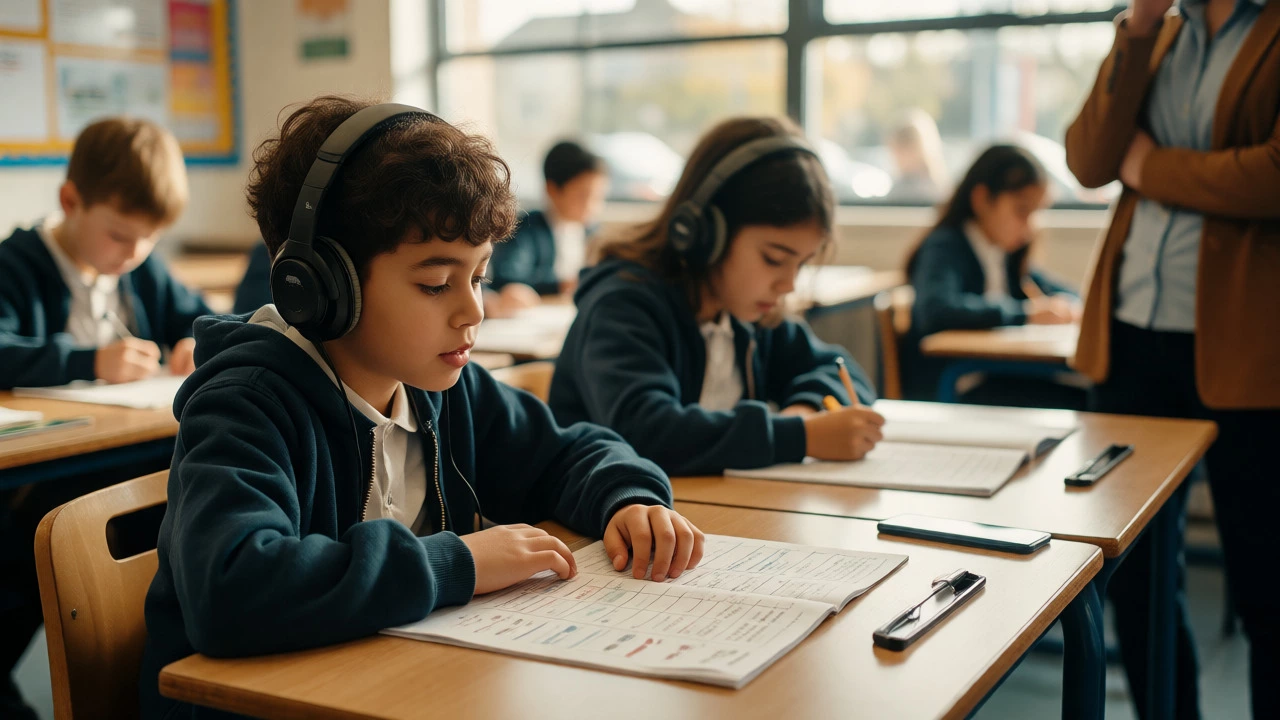
In schools, labels often get blurred due to administrative convenience. A teacher sees a student struggling to read and avoid eye contact. They might assume it is all part of one "package deal." But if you treat an autistic student’s refusal to read aloud solely as a literacy issue, you miss the point. They might be able to decode words perfectly but refuse to speak in front of peers due to social anxiety or sensory overload. Treating it as just a learning disability means you give them phonics drills. Treating it as autism means you give them a quiet corner and noise-canceling headphones. Both might be needed, but for different reasons.
The "Hidden" Curriculum: Social Communication
One of the biggest myths is that autism only affects "social butterflies." It doesn't. It affects how information is exchanged. For a student with a pure learning disability like dysgraphia, the struggle is physical and cognitive-they know what they want to say, but their hand won't write it fast enough. For an autistic student, the struggle might be understanding the unspoken rules of the assignment. "Be creative" is a vague instruction. An autistic learner often thrives on concrete, explicit instructions.
This distinction matters for assessment. Standardized tests often measure processing speed and verbal fluency. Autistic students might stall on these not because they don't know the answer, but because they are analyzing the ambiguity of the question itself. A learning disability assessment looks for gaps in academic skill acquisition. An autism evaluation looks for differences in social reciprocity and restricted, repetitive patterns of behavior. If you conflate the two, you risk misdiagnosing a bright autistic child as "slow," or vice versa.
Comorbidity: When Both Are Present
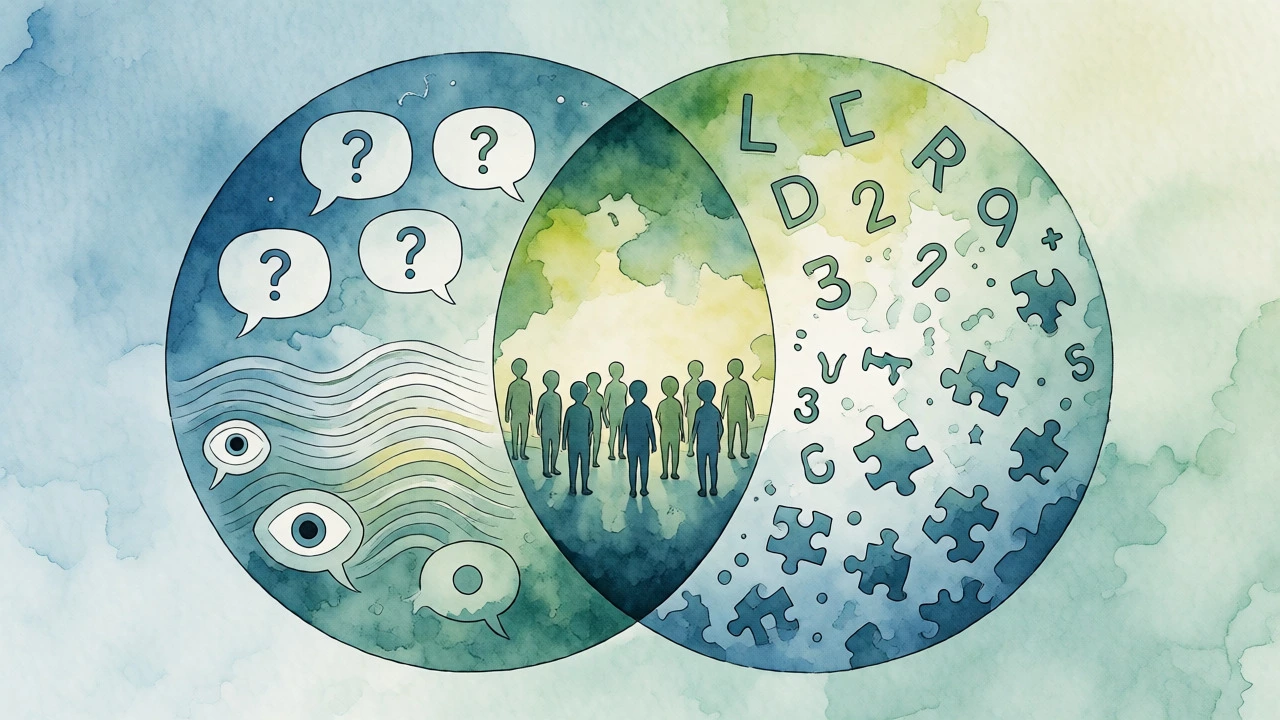
It is common for a person to have both ASD and a learning disability. This is called co-occurrence. Imagine a student who is autistic and has dyslexia. Their profile is complex. They might hyper-focus on a topic of interest (an autistic trait) and become an expert in dinosaurs, memorizing every name (high retention). Yet, they cannot read the textbook chapter on paleontology because of dyslexia.
Support here requires a dual approach. You cannot just provide audiobooks (helpful for dyslexia) if the environment is too loud for their sensory sensitivity (autism). You cannot just give them a visual schedule (helpful for autism) if they still cannot decode the written tasks (dyslexia). Effective special needs education demands looking at the whole child, not just checking boxes on a diagnostic manual.
How Schools Should Handle the Distinction
If you are a parent or educator, your job is to advocate for clarity. Here is how to navigate the system:
- Ask for separate evaluations. If a child is struggling socially and academically, ask for a full psychoeducational battery. This should include cognitive testing, achievement testing, and behavioral observations.
- Focus on strengths, not deficits. Autistic students often have strong visual-spatial skills or deep factual knowledge. Use these to bridge learning gaps caused by disabilities.
- Request specific accommodations. Don't accept generic "extra time." Ask for what solves the problem. Is it noise reduction? Text-to-speech software? A scribe? A break room?
- Watch for masking. Many autistic girls and women mask their traits until secondary school. By then, the academic load triggers a breakdown that looks like a learning disability failure but is actually burnout from social camouflage.
Legal and Educational Frameworks
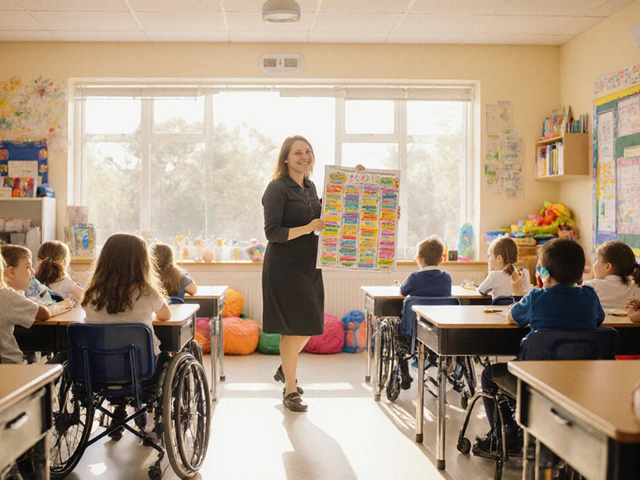
In the United States, under the Individuals with Disabilities Education Act (IDEA), autism and specific learning disabilities are distinct eligibility categories. A student qualifies for services based on how the condition impacts their educational performance. In Ireland and the UK, frameworks differ slightly, using terms like "Additional Support Needs," but the principle remains: the support must match the barrier.
Understanding the legal definitions helps in securing resources. If a school claims a child is "just lazy" because they have autism, you can point to the neurodevelopmental nature of the condition. If a school denies support for dyslexia because the child is "smart," you can point to the discrepancy between IQ and achievement scores. Knowing the terminology gives you leverage.
Final Thoughts: Respect the Nuance
Language shapes reality. Calling autism a learning disability erases the unique social and sensory experiences of autistic people. Calling a learning disability autism pathologizes a cognitive difference that is purely academic. We need to stop trying to fit every struggling student into one box.
The goal isn't to fix the brain. It is to remove the barriers that prevent learning. Whether that barrier is a noisy classroom, a confusing social rule, or a lack of phonemic awareness, identifying it correctly is the first step toward success. So next time you see a child struggling, ask yourself: Is this a matter of how they connect with others, or how they process data? The answer will guide you to the right help.
Can a person have autism without a learning disability?
Yes, absolutely. Many autistic individuals have average or above-average intelligence and no specific learning disabilities. They may excel in academics but struggle with social interactions or sensory environments. Autism is a spectrum, and intellectual capability varies widely among autistic people.
Is dyslexia considered a type of autism?
No, dyslexia is a specific learning disability related to reading and language processing. It is not on the autism spectrum. However, a person can have both dyslexia and autism simultaneously. They are distinct conditions with different neurological origins and symptoms.
Why do autistic students sometimes fail standard tests?
Standard tests often rely on social context, ambiguous instructions, or rapid verbal responses, which can disadvantage autistic students. Additionally, sensory issues like fluorescent lights or background noise can disrupt concentration. This doesn't reflect a lack of knowledge or ability, but rather a mismatch between the testing environment and the student's neurological needs.
Do learning disabilities affect social skills?
Not directly. A learning disability primarily affects academic skills like reading or math. However, the frustration, low self-esteem, or social stigma associated with struggling in school can indirectly impact social confidence. This is different from the core social communication challenges inherent in autism.
What is the best way to support a student with both conditions?
A holistic approach is best. Combine evidence-based interventions for the learning disability (such as Orton-Gillingham for dyslexia) with autism-friendly accommodations (like structured routines, sensory breaks, and clear visual schedules). Collaboration between special education teachers, psychologists, and parents is crucial to tailor the support plan effectively.






Write a comment