
GCSE Grade Converter & Guide
Select a grade below to see its equivalent in the other system and understand its significance for university and employment.
Quick Reference Chart
| New Grade | Old Equivalent | Significance |
|---|---|---|
| 9 | A* | Exceptional performance, above previous top grade. |
| 8 | A* | High achievement, equivalent to old A*. |
| 7 | A | Strong pass, often required for competitive courses. |
| 6 | B | Good pass, meets many employer thresholds. |
| 5 | High C | Considered a "strong pass" by the government. |
| 4 | C | Standard pass, minimum requirement for most jobs. |
| 3 | D | Below standard, may require retakes in core subjects. |
| 2 | E/F | Limited achievement. |
| 1 | G | Lowest awarded grade. |
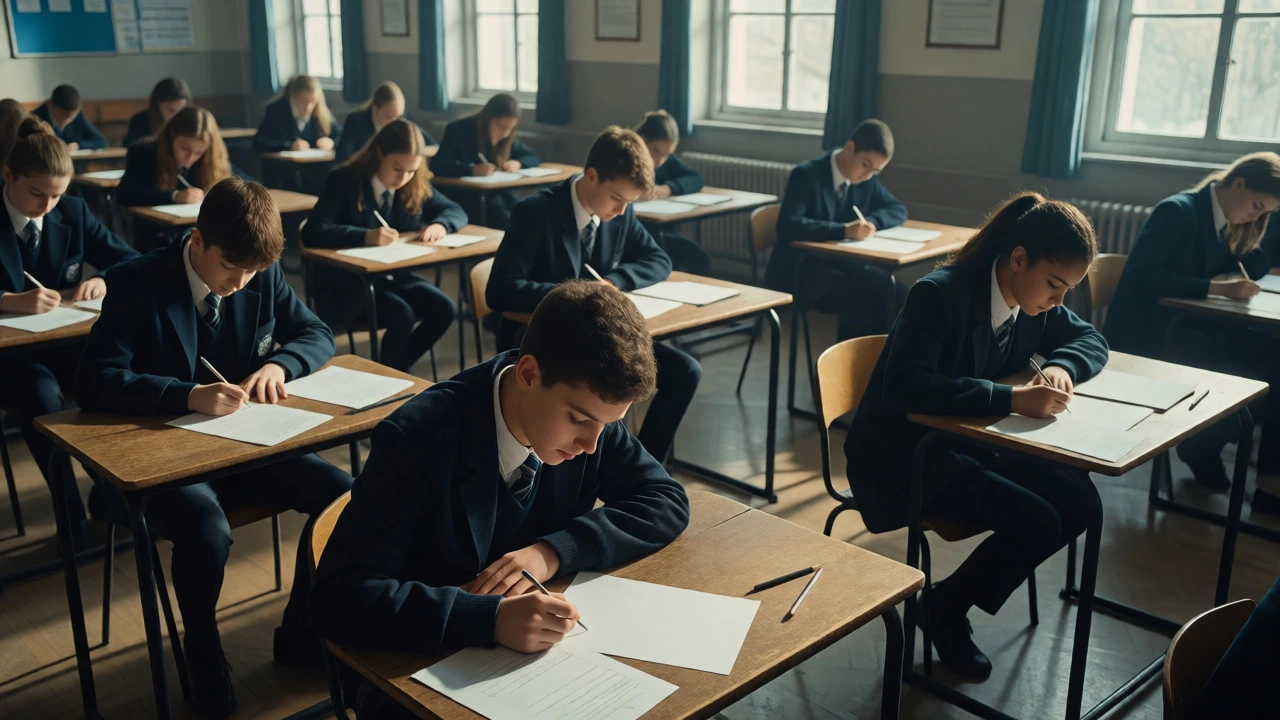
You hear the acronym GCSE everywhere. It’s on job listings, university entry requirements, and in every conversation between parents worrying about their child's future. But if you stop and think about it, what does it actually stand for? And more importantly, why does this specific set of exams hold so much power over a teenager's life?
For anyone new to the UK education system-whether you’re an international student, a parent moving from abroad, or just someone trying to understand your own old report cards-the terminology can be confusing. Is it like the American SATs? Is it like the French Baccalauréat? The short answer is: no, it’s its own thing. Understanding what a GCSE is helps you navigate everything from choosing subjects at age 14 to applying for your first real job.
The Core Definition
General Certificate of Secondary Education (GCSE) is an academic qualification taken by students in England, Wales, and Northern Ireland, typically completed at age 16. It marks the end of compulsory secondary education in these regions. While Scotland uses a different system called National 5s, the GCSE remains the benchmark for educational achievement across most of the UK.
The "General" part means it covers a broad range of subjects rather than specializing early. The "Certificate" part confirms it’s a formal award recognized by employers and universities. The "Secondary Education" part places it squarely in the middle of a student's schooling journey, right before they decide whether to leave school or stay on for A-Levels.
Why Do These Exams Matter So Much?
Think of GCSEs as the gatekeepers. They are the first major external assessments that count toward your future. Before this, you might have had internal school tests, but those didn’t carry the same weight outside your classroom. GCSEs are graded by independent exam boards, which makes them standardized and comparable nationwide.
If you want to go to university, you need good GCSEs in English and Maths. If you want to become a doctor, you likely need high grades in Sciences too. Even if you leave school at 16 to start an apprenticeship, employers look at these results to gauge your literacy, numeracy, and work ethic. It’s not just about passing; it’s about proving you can handle pressure and meet national standards.
How Are GCSEs Graded? The 9-1 System
This is where things get tricky for many people because the grading system changed recently. For decades, GCSEs used letters from A* to G. Now, most subjects use a numerical scale from 9 to 1.
| New Grade (9-1) | Old Equivalent (A*-G) | Meaning |
|---|---|---|
| 9 | A* | Exceptional performance, above the previous top grade. |
| 8 | A* | High achievement, equivalent to the old A*. |
| 7 | A | Strong pass, often required for competitive courses. |
| 6 | B | Good pass, meets many employer thresholds. |
| 5 | High C | Considered a "strong pass" by the government. |
| 4 | C | Standard pass, the minimum requirement for most jobs. |
| 3 | D | Below standard, may require retakes in core subjects. |
| 2 | E/F | Limited achievement. |
| 1 | G | Lowest awarded grade. |
Why the switch? The government wanted to differentiate the highest achievers better. In the old system, an A* was rare, but with the new system, a grade 9 is reserved for the very top tier of students. If you see a job ad asking for "Grade 4 or above," they mean the old Grade C. If a university asks for a "Grade 7," they mean the old Grade A.
What Subjects Do You Take?
You don’t just pick whatever you feel like. There’s a mix of mandatory and optional subjects. By the time you finish Year 11 (the final year of compulsory schooling), you’ll usually have studied around 8 to 10 GCSEs.
- English Language & Literature: Mandatory. You study both fiction and non-fiction texts, poetry, and creative writing.
- Mathematics: Mandatory. Covers algebra, geometry, statistics, and probability.
- Science: Usually mandatory. You either take "Combined Science" (worth two GCSEs) or separate Biology, Chemistry, and Physics (each worth one GCSE).
- Humanities: Often includes History, Geography, or Religious Studies. Some schools make one of these compulsory.
- Languages: French, Spanish, German, etc. Highly recommended for university applications, though sometimes optional.
- Arts & Technology: Art, Music, Drama, Design & Technology, Computer Science. These allow you to showcase creativity or technical skills.
Choosing subjects is a strategic move. If you want to be an engineer, taking Further Maths or Physics is smart. If you want to be a lawyer, History or English Literature helps develop critical analysis skills. Talk to teachers early; they know which combinations open doors.
Who Sets the Exams?
Schools don’t write the papers. Independent organizations do. In England, there are three main exam boards:
- AQA (Assessment and Qualifications Alliance): One of the largest providers, known for rigorous science and humanities papers.
- Edexcel (Pearson): Popular for maths and business studies, offering modular options in some subjects.
- OCR (Oxford Cambridge and RSA): Known for flexible specification options, particularly in sciences and languages.
Wales has its own board, WJEC/Eduqas. It doesn’t matter much to you as a student which board your school uses, except when you’re buying revision guides. Make sure you buy the book for the correct board! Using an AQA guide for an Edexcel exam will confuse you because the content order and question styles differ slightly.
How Is Assessment Done?
Most GCSEs are assessed entirely through written exams at the end of Year 11. This is a big shift from the past, where coursework counted for up to 40% of the grade. Today, only a few subjects retain significant coursework components, such as Art, Design & Technology, and some language speaking/listening elements.
This change puts more pressure on exam performance. If you have a bad day during the exam, your whole grade suffers. There’s no safety net of accumulated coursework marks. Preparation becomes crucial. Past papers are your best friend here-they show you exactly how questions are phrased and how marks are awarded.

What Happens After GCSEs?
Once you get your results in August, you face a fork in the road. Here are the common paths:
- A-Levels: Stay in school or college for two years, studying 3-4 subjects in depth. This is the traditional route to university.
- Vocational Courses (BTECs/T Levels): More practical, hands-on learning. Great for careers in engineering, health, IT, or construction.
- Apprenticeships: Work while you learn. You earn a wage and gain experience. Higher apprenticeships can lead to degree-level qualifications without university debt.
- Retaking GCSEs: If you failed English or Maths (grade below 4), you must retake them until you pass or turn 18. Many colleges offer evening classes for this.
Don’t panic if your grades aren’t perfect. Life isn’t defined by a single certificate. Plenty of successful people had average GCSEs. What matters is what you do next. Use your strengths. If you got low grades in Maths but high grades in English, lean into communication-based roles or studies.
Common Misconceptions About GCSEs
Let’s clear up some myths that cause unnecessary stress.
Myth 1: You need all A*s to succeed. False. Most universities ask for 5 GCSEs at grade 4/C or above, including English and Maths. Only highly competitive courses demand straight 9s/As.
Myth 2: GCSEs are the same as SATs. No. SATs in the US are aptitude tests taken once, often multiple times. GCSEs are subject-specific knowledge tests taken at the end of a two-year course. You can’t resit a GCSE easily like you can retake a SAT.
Myth 3: If you fail, you’re doomed. Not true. Retakes are common. Many adults go back to night school to improve their grades later in life. Employers care more about current skills and attitude than grades from five years ago.
Tips for Surviving GCSE Season
If you’re currently revising, here’s some practical advice from experience:
- Start Early: Don’t cram the night before. Spaced repetition works better. Review topics weekly.
- Use Active Recall: Close the book and try to explain the concept out loud. If you can’t, you don’t know it yet.
- Past Papers Are King: Doing practice exams under timed conditions is the single best way to improve grades. Mark them strictly using official mark schemes.
- Sleep Matters: Your brain consolidates memory during sleep. Pulling all-nighters often hurts more than it helps.
- Ask for Help: Teachers love answering specific questions. Don’t sit there confused. Go to them with a specific problem: "I don’t understand how to solve quadratic equations by factorizing." That’s easier for them to help with than "I’m bad at maths."
Understanding what a GCSE is demystifies the process. It’s just a series of exams testing what you’ve learned over two years. It’s challenging, yes, but it’s manageable with the right strategy. Whether you’re aiming for Oxford or an apprenticeship in plumbing, these qualifications are your starting block. Respect them, prepare for them, but don’t let them define your entire worth.
Is a GCSE equivalent to an O-Level?
Yes, broadly speaking. The O-Level was replaced by the GCSE in 1988 in the UK. If you see older job ads or CVs mentioning O-Levels, they refer to the same level of qualification as today’s GCSEs. However, the grading scales differ (old O-Levels used A-G, now we use 9-1).
Can I take GCSEs privately?
Absolutely. You don’t need to be enrolled in a school to sit GCSE exams. Private candidates register directly with exam boards like AQA, Edexcel, or OCR. This is popular for homeschoolers, adults upgrading qualifications, or international students who want UK-standard credentials.
Do Scottish students take GCSEs?
No, Scotland has its own system. Students typically take National 5 qualifications at age 16, which are roughly equivalent to GCSEs. Some private schools in Scotland may offer GCSEs alongside or instead of National 5s, but state schools follow the Scottish curriculum.
What is the difference between Combined Science and Separate Sciences?
Combined Science counts as two GCSEs and covers less depth in each area. Separate Sciences (Biology, Chemistry, Physics) count as three GCSEs and provide deeper content. Universities often prefer separate sciences for medicine or engineering degrees, but combined is sufficient for many other courses.
Are GCSEs hard?
They are demanding but fair. The difficulty varies by subject and individual strength. Math and foreign languages tend to be perceived as harder due to cumulative knowledge requirements. However, with consistent revision and understanding the exam format, most students achieve their target grades. It’s less about genius and more about discipline.





Write a comment