

Post-GCSE Pathway Finder
Not sure what to do next? Answer three quick questions to find a pathway that matches your learning style and goals.
Recommended Pathway:
You open the envelope. Or maybe you check the results day portal on your phone with shaking hands. There it is: a Grade 3 in Maths. Or perhaps an unclassified result in English Language. For many students, this feels like the end of the road. The panic sets in immediately. "Did I just ruin my future?" "Do I have to leave school now?"
Here is the truth that might surprise you: failing a GCSE General Certificate of Secondary Education, a UK academic qualification taken by students aged 14-16 is not a career death sentence. It is a detour, not a dead end. In fact, thousands of successful professionals started their journey with grades that didn't meet their initial hopes. The key is understanding exactly what happens next and which doors remain open.
The Immediate Aftermath: What Actually Happens?
First, take a breath. Nothing catastrophic happens physically or legally when you get a low grade. Your school will still offer support, but the landscape changes slightly depending on whether you failed one subject or several.
If you missed the pass mark (usually a Grade 4 under current grading systems) in core subjects like English or Maths, most schools will encourage you to retake these exams. This isn't a punishment; it's a strategic move. Why? Because employers and colleges often view a retaken GCSE as evidence of resilience. They want to see that you can handle setbacks.
However, if you failed optional subjects like History or French, you usually don't need to retake them unless they are specific prerequisites for a course you desperately want. Focus your energy where it counts.
Your Three Main Paths Forward
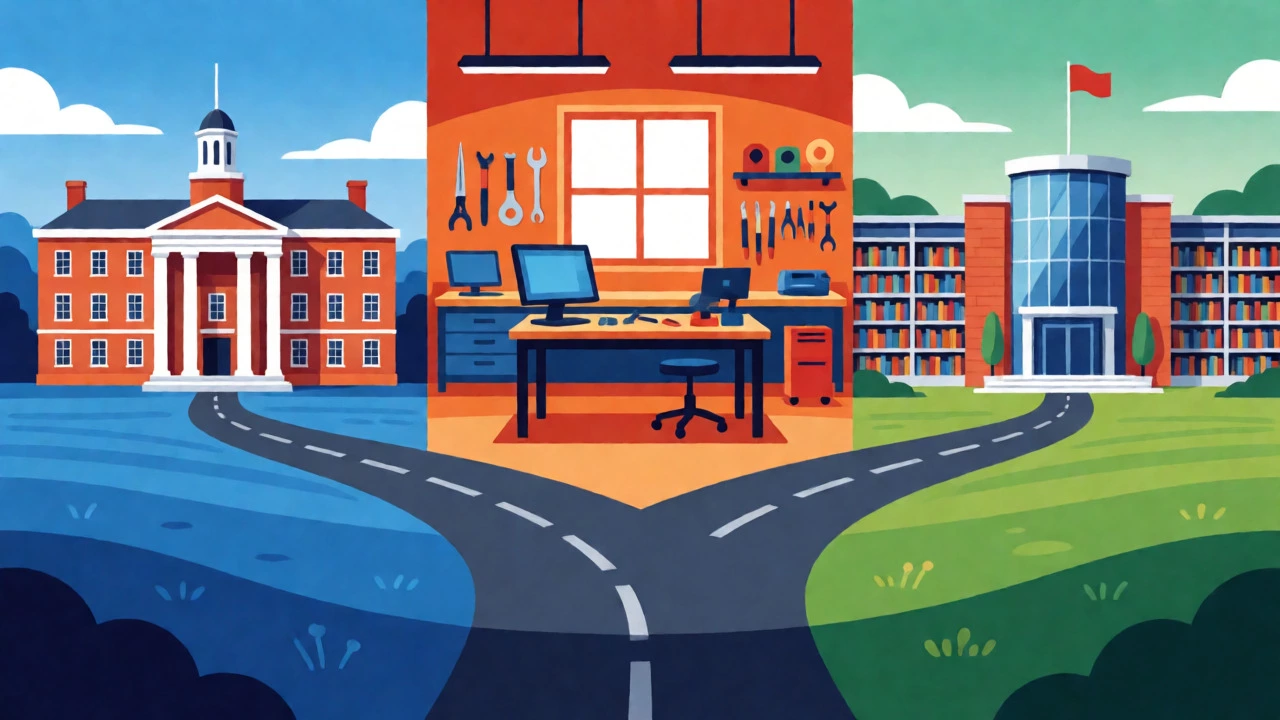
Once the initial shock wears off, you have three primary routes. Choosing the right one depends on your learning style, career goals, and how much academic pressure you can handle right now.
Option 1: Retaking GCSEs at School or College
This is the most common route for students who narrowly missed out or feel confident they can improve. Many sixth forms and colleges allow you to study A-Levels while simultaneously retaking GCSE Maths or English. This is known as a "mixed programme."
Pros: You stay in an educational environment. You keep your friends around. You fix the missing qualifications without delaying your higher education too long.
Cons: It’s heavy workload. Balancing new A-Level content with old GCSE revision requires serious time management skills. If you struggled with the original material, doing it again alongside harder subjects can be stressful.
Option 2: Vocational Qualifications and Apprenticeships
Let’s be honest: not everyone thrives in a classroom. If sitting exams makes you anxious, look into vocational paths. Apprenticeships training programs combining work experience with study are booming in the UK. Employers in engineering, digital tech, and health care often prioritize attitude and practical skill over perfect GCSE grades.
Consider BTECs Business and Technology Education Council vocational qualifications. These are graded continuously through coursework rather than a single high-stakes exam. If you are better at doing things than memorizing facts, a BTEC in Business or Health and Social Care might suit you far better than traditional A-Levels.
| Pathway | Best For | Key Benefit | Main Challenge |
|---|---|---|---|
| Retake GCSEs + A-Levels | University-bound students | Keeps all university doors open | High academic pressure |
| Vocational Courses (BTEC) | Hands-on learners | Continuous assessment, less exam stress | Limited access to some elite universities |
| Apprenticeships | Work-ready individuals | Earn money while learning | Competitive entry requirements |
Option 3: T-Levels and Technical Routes
Newer to the scene are T-Levels technical qualifications equivalent to three A-Levels. Introduced recently, these combine classroom learning with a 45-day industry placement. They are designed specifically for students who know what sector they want to enter but don't want a purely academic degree. Failing a few GCSEs doesn't necessarily block you from T-Levels, provided you show commitment and basic literacy/numeracy skills during interviews.
Does Failing GCSEs Affect University Entry?
This is the big question. Does a Grade 3 in Maths mean you can never go to Oxford or Cambridge? Not necessarily, but it complicates things.
Russell Group universities typically require a Grade 4 or 5 in English and Maths. If you don't have it, you must retake it before starting your degree. Some universities are flexible if you achieve high A-Level grades, arguing that your recent performance outweighs past struggles. Others are strict gatekeepers.
Open Universities and many modern institutions focus more on your personal statement and interview performance. They look at your potential, not just your history. So, if you plan to go to university later, you might consider taking a gap year to work, save money, and retake exams in a lower-pressure environment.
Mental Health and Motivation: How to Cope
Results day depression is real. You might feel like a failure compared to peers who got straight 8s and 9s. But remember: grades measure memory and exam technique, not intelligence or worth.
Talk to someone. Teachers, parents, or careers advisors have seen this scenario a hundred times. They know the shortcuts and the second chances. Don't isolate yourself. Join a study group if you decide to retake. Changing your environment can change your mindset.
Set small, achievable goals. Instead of saying "I need to pass Maths," say "I will complete five algebra problems today." Small wins rebuild confidence faster than grand promises.

Real-Life Scenarios: What Did Others Do?
Consider Sarah, who failed her Science GCSEs. She wanted to be a nurse. She couldn't do A-Levels because she lacked the required science background. Instead, she took a Level 3 Diploma in Health and Social Care at a local college. She excelled in the practical modules. Two years later, she was accepted into a nursing degree program with a distinction average. Her failed GCSEs became a footnote in her CV, not a headline.
Then there’s James. He failed English Literature but loved coding. He skipped sixth form entirely and applied for a digital marketing apprenticeship. The company cared about his portfolio and his willingness to learn, not his essay-writing skills. Today, he runs his own agency. His path wasn't linear, but it worked.
Action Plan: What To Do Right Now
Don't wait until September ends. Take action immediately:
- Contact your school’s careers advisor. Ask specifically about retake deadlines. Most autumn sittings close registration by mid-July or early August, so check if you missed the window or if spring sittings are available.
- Review your interests. Do you actually want to continue academically? Be honest. If you hate studying, forcing yourself through two more years of exams might lead to burnout.
- Look at alternative providers. Private tutorial centers often offer intensive short courses for GCSE retakes. They can be expensive but effective if you need targeted help.
- Check employer requirements. If you know your dream job, call them. Ask if they accept equivalent qualifications. You might find out that a BTEC is perfectly acceptable.
Failing GCSEs forces you to think differently. It pushes you out of the default "school-college-university" pipeline and makes you ask: what do I actually want to do? That clarity is valuable. Many people drift through degrees they don't enjoy. By hitting a wall now, you’re being forced to choose a path that fits you better.
So, breathe. Pick up the phone. Make a plan. Your story isn't over; it’s just entering a new chapter.
Can I retake GCSEs outside of school?
Yes. You can register as a private candidate with any accredited exam center. This includes local colleges, private tutoring centers, or even other schools. You won't attend classes, but you sit the same exams. This is ideal if you are working or prefer self-study.
Do I have to retake all my failed GCSEs?
No. You only need to retake subjects that are essential for your next step. For example, if you want to go to university, Maths and English are usually mandatory. Optional subjects like Art or Geography can often be left alone unless specified by a particular course.
How much does it cost to retake a GCSE?
If you are enrolled in full-time education (like sixth form), retakes are often free or included in your fees. As a private candidate, exam fees vary but typically range from £40 to £60 per subject. Additional costs may apply for tuition if you hire a tutor.
Will failing GCSEs affect my job prospects forever?
Rarely. While some graduate schemes screen for GCSE grades, most employers eventually focus on your degree, work experience, and skills. Once you gain professional experience, your GCSE results become irrelevant to most hiring managers.
Is it better to retake in Autumn or Spring?
Autumn sittings (November) allow you to potentially start A-Levels or college courses sooner. Spring sittings (March/April) give you more time to revise but delay your progression. Choose based on how prepared you feel and your timeline for further education.






Write a comment