

Special Education Classification Explorer
Prevalence of Special Education Categories
Based on National AveragesClick on any bar to learn more about that specific classification, its characteristics, and how it impacts student support.
Select a Category
Explore the data to understand why Specific Learning Disabilities dominate special education statistics and how other categories like ADHD and Autism are growing.
Key Characteristics & Support
Use the chart above to discover which disability category affects the most students and what specific interventions are required for each group.
Walk into any public school classroom in the United States today, and you will likely see a diverse mix of learning styles. But if you look at the official paperwork-the Individualized Education Programs (IEPs) and eligibility reports-there is one category that consistently dominates the numbers. It isn't physical impairment, nor is it intellectual disability. The most common disability classification in special education is specific learning disabilities.
This fact often surprises people who assume autism or attention deficit hyperactivity disorder (ADHD) would take the top spot due to their high visibility in media and culture. While those conditions are indeed prevalent and growing in diagnosis rates, "Specific Learning Disability" (SLD) remains the statistical heavyweight. Understanding why this is the case requires looking past the label and into how schools define, identify, and categorize learning challenges under federal law.
The Dominance of Specific Learning Disabilities (SLD)
To understand the landscape of special education, we have to look at the data from the U.S. Department of Education's Office of Special Education Programs (OSEP). For decades, SLD has accounted for roughly 33% to 34% of all students receiving special education services. That means nearly one in three students on an IEP falls into this bucket.
| Disability Category | Approximate Share of Total | Common Conditions Included |
|---|---|---|
| Specific Learning Disability (SLD) | ~33% | Dyslexia, Dyscalculia, Dysgraphia |
| Speech or Language Impairment | ~19% | Articulation disorders, Fluency issues |
| Autism Spectrum Disorder (ASD) | ~17% | Level 1, 2, and 3 Autism |
| Other Health Impairment (OHI) | ~15% | ADHD, Anxiety Disorders |
| Intellectual Disability | ~8% | Down Syndrome, Fragile X |
Why does SLD lead the pack? The answer lies in the definition. Under the Individuals with Disabilities Education Act (IDEA), SLD is defined as a disorder in one or more of the basic psychological processes involved in understanding or using language. This is a broad net. It catches students who struggle specifically with reading (dyslexia), writing (dysgraphia), or math (dyscalculia), even if they have average or above-average intelligence.
Because these struggles are tied directly to academic performance, they are often identified early. A child who cannot decode words by third grade is flagged immediately. In contrast, some behavioral or social-emotional challenges might be attributed to personality or environment before being classified as a disability requiring formal services.
The Rise of Other Health Impairment (OHI) and ADHD
If SLD is the steady leader, Other Health Impairment (OHI) is the fastest-growing contender. You might wonder why ADHD doesn't have its own category. It doesn't. Instead, ADHD falls under OHI. The IDEA defines OHI as having limited strength, vitality, or alertness, including heightened alertness to environmental stimuli, that adversely affects educational performance.
In recent years, the percentage of students classified under OHI has jumped significantly, now hovering around 15-16%. This surge is largely driven by increased awareness and diagnosis of ADHD. Teachers are better trained to recognize signs of inattention and hyperactivity, and parents are more proactive in seeking evaluations. Unlike SLD, which manifests primarily in academic output, OHI affects executive function, focus, and emotional regulation across all settings.
The distinction matters for support strategies. An SLD student might need specialized reading instruction (like Orton-Gillingham methods). An OHI/ADHD student might need behavioral interventions, frequent breaks, or medication management plans alongside academic accommodations. As schools shift toward recognizing neurodiversity, the lines between these categories sometimes blur, but the legal classification remains distinct.
Autism Spectrum Disorder: High Visibility, Second Place Numbers
Autism Spectrum Disorder (ASD) holds the third spot, covering about 17% of special education enrollments. However, don't let the ranking fool you; ASD is the fastest-growing *new* identification category over the last two decades. Why isn't it number one? Partly because the diagnostic criteria have expanded to include higher-functioning individuals who might previously have been missed or misclassified under emotional disturbance or intellectual disability.
Autism presents differently than SLD. While an SLD student might understand a concept but fail to write it down, an autistic student might struggle with social communication, sensory processing, or rigid thinking patterns that impact learning. Schools are increasingly adopting Universal Design for Learning (UDL) principles to support autistic students, focusing on flexibility in how information is presented and how students demonstrate knowledge.
The growth in ASD diagnoses reflects a broader cultural shift. We are no longer just identifying children with severe support needs. We are recognizing mild cases where the individual thrives with the right accommodations, such as noise-canceling headphones or visual schedules. This inclusivity drives up the numbers, but also improves outcomes for thousands of students who were previously overlooked.
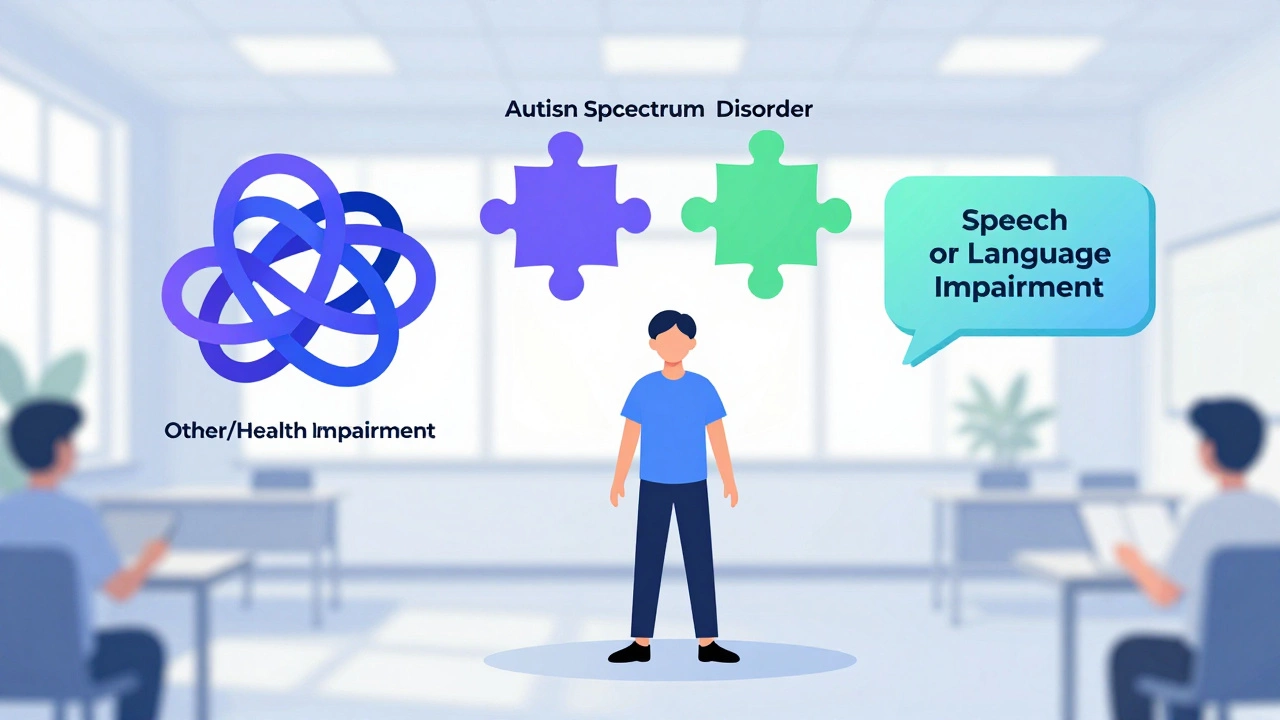
Speech or Language Impairment: The Silent Majority
Sitting comfortably in second place is Speech or Language Impairment (SLI), accounting for nearly 19% of cases. This category includes articulation problems (difficulty pronouncing sounds), fluency issues (stuttering), and voice disorders. But it also covers receptive and expressive language disorders.
Many parents don't realize that a language delay can qualify a child for special education services. If a child cannot follow multi-step directions or express their needs clearly, their academic progress stalls. SLI is often a precursor to other learning difficulties. For example, untreated phonological awareness issues in preschool often lead to dyslexia in elementary school. Early intervention in speech therapy is crucial here, not just for communication, but for preventing secondary academic failures.
How Classifications Impact Student Support
Knowing which disability is most common isn't just a trivia point; it dictates resource allocation. Schools must budget for specialists based on these categories. Since SLD is the largest group, schools invest heavily in reading specialists and learning interventionists. However, the rise in OHI and ASD means schools are also hiring more behavior analysts and occupational therapists.
The classification determines the type of evaluation a student receives. For SLD, schools use Response to Intervention (RTI) data to show that general education strategies failed before labeling the student. For ASD, clinical observations and developmental history play a larger role. For OHI, medical documentation from a physician is often required to establish the diagnosis of ADHD or anxiety.
Parents should understand that the label is a tool, not a destiny. The goal of special education is to provide Free Appropriate Public Education (FAPE). Whether your child is classified under SLD, OHI, or ASD, the IEP team must design a plan that addresses their unique needs. Sometimes, students have multiple disabilities. A child might have both dyslexia (SLD) and ADHD (OHI). In these cases, the primary disability is chosen for reporting purposes, but the IEP addresses both.

Regional Variations and Diagnostic Trends
It is important to note that national averages mask local realities. In some states, the rate of ASD diagnosis is double the national average. In others, SLD rates are declining as schools implement better universal screening for reading risks, catching issues before they require special education placement. This phenomenon is known as "prevention through early intervention."
Additionally, socioeconomic factors play a role. Studies suggest that minority students and students from low-income backgrounds are sometimes overrepresented in certain categories like Intellectual Disability or Emotional Disturbance, while being underrepresented in Gifted programs. Conversely, white and Asian students are often overrepresented in ASD and SLD categories. These disparities highlight the need for culturally responsive assessment practices to ensure fair and accurate classifications.
What This Means for Parents and Educators
If you are a parent navigating the special education system, knowing that SLD is the most common category can be reassuring. It means there is a vast amount of research, training, and resources dedicated to supporting learning differences. You are not alone. There are established methodologies for teaching reading, writing, and math to students with these profiles.
For educators, the dominance of SLD and the rise of OHI/ASD signal a need for differentiated instruction. One-size-fits-all teaching no longer works. Teachers must be prepared to scaffold lessons, provide multimodal inputs (visual, auditory, kinesthetic), and offer flexible assessment options. Professional development in trauma-informed care and neurodiversity-affirming practices is becoming essential, not optional.
Ultimately, the "most common" title shifts slightly year by year, but the core message remains: learning differences are widespread. By understanding the landscape of special education disabilities, we can move away from stigma and toward effective, personalized support for every child.
Is ADHD considered a learning disability?
Technically, no. ADHD is classified as an "Other Health Impairment" (OHI) under the Individuals with Disabilities Education Act (IDEA). However, it is often grouped with learning disabilities in casual conversation because it significantly impacts a student's ability to learn, focus, and complete academic tasks. While a learning disability like dyslexia affects how the brain processes specific information (like letters or numbers), ADHD affects executive functions like attention, impulse control, and organization.
What is the difference between SLD and Intellectual Disability?
The key difference lies in cognitive potential. Students with Specific Learning Disabilities (SLD) typically have average or above-average intelligence but struggle with specific academic skills like reading or math. Students with Intellectual Disability (ID) have significant limitations in both intellectual functioning (IQ) and adaptive behavior (daily life skills). An SLD student might need help decoding words but can understand complex concepts; an ID student may need support with basic self-care and fundamental academic concepts.
Why are so many children diagnosed with Autism recently?
The increase in Autism Spectrum Disorder (ASD) diagnoses is due to several factors: broader diagnostic criteria that include milder cases, greater public awareness, and improved screening tools. It is not necessarily because more children are developing autism, but rather that we are identifying it earlier and more accurately. Previously, many high-functioning autistic children were misdiagnosed with emotional disturbances or simply labeled as "difficult."
Can a child have more than one special education classification?
Yes, this is called co-morbidity. For example, a child might have both Dyslexia (SLD) and ADHD (OHI). When filing for special education services, the school district usually selects one "primary" disability for reporting purposes, but the Individualized Education Program (IEP) must address all areas of need. The IEP team will create goals and accommodations that support both the learning difference and the attention/executive function challenges.
Does a specific learning disability go away?
No, specific learning disabilities are lifelong neurological differences. However, with proper intervention and strategies, students can become highly successful readers, writers, and mathematicians. Many adults with SLD develop compensatory strategies and use technology (like text-to-speech software) to manage their challenges. The goal of special education is not to "cure" the disability but to equip the student with the tools they need to thrive academically and professionally.







Write a comment